Showing posts with label hungry history. Show all posts

Wednesday, March 23, 2016

Hungry History: Amazing Adobo, Part II!

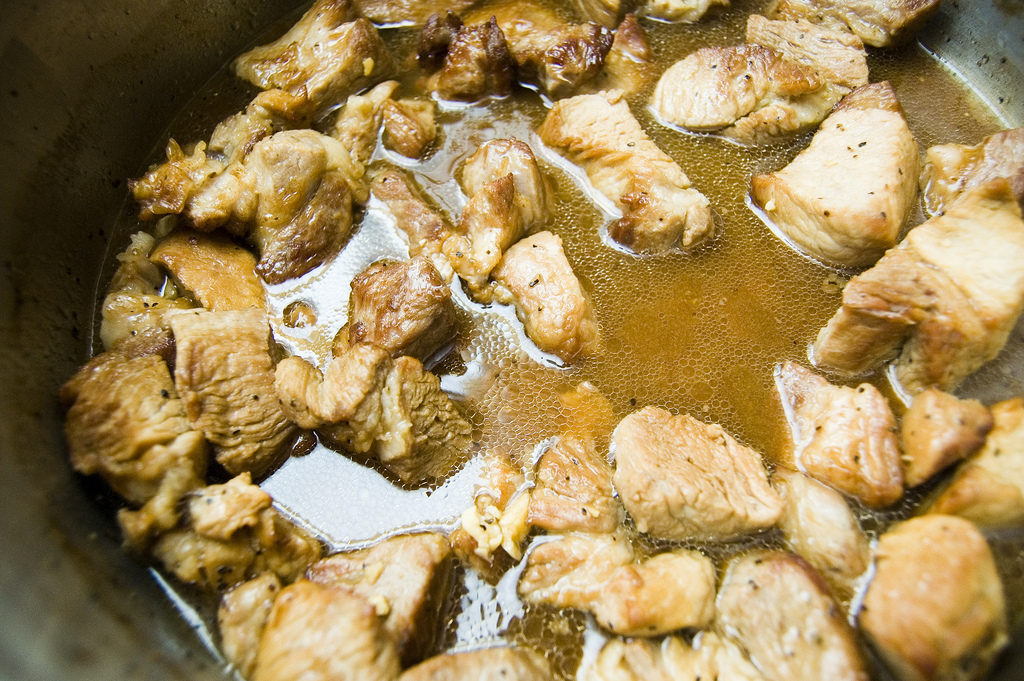
Philippine_pork_adobo_cooked_in_a_kawali.jpg

Succulent pork adobo, notice the specks of pepper and the richly colored broth. Diverse spices are often coarsely chopped and dumped into the pot ahead of (or during) cooking.


Fabulous Filipino Adobo In Fifteen Minutes Prep

Don’t Have Time to Cook

Like you, I have days full of commitments. I’m not always able to eat wholesome, home-cooked meals, even when I want to. When I cook, often it is staple meals that, while comforting, don’t always expand my food horizons. On a particularly full day, I might resort to take-out or fast food, which reminds me just how hard I have to workout to counterbalance. As with any busy life, the answer is seeing where you can simplify.


I Already Simplify

I know, I know. You’ve already made things simpler for yourself. Maybe you’ve been cutting out unnecessary web surfing or cut the cable. Maybe you’ve even trimmed your budget and adjusted your work schedules to better balance in your work and life (in which case, this is a great way to help that goal!). Even so, sometimes there’s just not enough hours in the day to do everything we want to do. Sometimes, our meals suffer as a result. Shouldn’t the wellness of our bodies, the only one’s we know we get, be a priority? We can accomplish this in the kitchen with the investment in one basic but powerful tool.


Slow Cooker: Save Time, Eat Well

Take the hard work out of preparing a fresh, fantastically Filipino staple with this simple process using a fantastic, dump-and-forget style of cooking...the slow cooker! Slow cookers are versatile kitchen tools that can make breakfast oatmeal, lunch soups and dinner meatloaf, without taking up much counter space. Read on to learn more about this method, its benefits, and a recipe that can help you create your own family-style adobo at home with just fifteen minutes prep!
Chef_Pepin_Oval_Slow_Cooker.jpg
By Chef Pepín via Wikimedia Commons
Slow cookers are available at all big box stores and online retailers. Quality ones have more settings and temperature options to customize your cooking


Adobo Can Be Easy

Traditionally, adobo involves getting (or butchering!) just the right cuts of pork or chicken with a variety of veggies, spices and liquids, and boiling the mixture then letting it simmer for a few hours. Every family and every region in the Philippines has their own special recipe for their perfect adobo. With a slow cooker, you can skip the stovetop, and stove babysitting, and enjoy the full, home-style comfort flavors of this Filipino staple dish. Recipes abound, a quick Google search will give you so many ideas, but my favorite has a nice balance of Filipino vinegar (extra splash, courtesy of my Ilocano side!), soy sauce, garlic, bay leaves, pepper and a little seasoned salt. I also add potatoes and onion. You can definitely balance your favorite flavors, or adjust it for salt intake and other food considerations.

Exciting Meals with Big Benefits

512px-Chicken_adobo.jpg
By dbgg1979 on flickr (http://www.flickr.com/photos/dbgg1979/3880492441/) via Wikimedia Commons
Chicken adobo, bone-in for added flavor. Notice the bay leaves, they really make a difference! The drier skin is achieved by attentively searing the meat, allowing the broth to either cook out or reserving then readding a portion upon serving (depends on technique used).


Versatile
The beauty of Filipino adobo is that it is easily adaptable. There’s no “right” or “wrong” answer (though many families claim theirs is the best!) You can adapt the basic recipe provided here to suit your family’s needs. Try a robust vegetarian option, substituting your favorite stew-friendly, meaty vegetables. You can also adjust ingredients for food allergies (even soy, some recipes don’t have it!), protein preferences and levels of salt, sour and sweetness. Try experimenting and see which flavors work best for you and your family.


Easy
It takes more time to watch a daytime tv show than it does to prep this meal! Fifteen minutes means a home-cooked meal at the end of your busy day! Your home will also smell divine! Make sure to get all your ingredients and cutting surfaces, pots and utensils set up beforehand, and you save even more time! Just prepare the meats and vegetables, the marinade and preheat the slow cooker. You can safely leave it on throughout the day without threat of overcooking (follow your own slow cooker manufacturer’s instructions).


Nearly Foolproof
Because the slow cooker uses very low, slow heat, there’s very little that can go wrong with this dish. The important thing is to use the right cuts of meat, with a little fat in them, to ensure the protein doesn’t dry out. Also, cut your vegetables and meats to roughly the same size, or adjust, to ensure everything cooks properly. The recipe below provides more than enough soup to pour over the rice and avoid burning during cooking, but if adjustments are made you may want to check the pot occasionally.


Delicious
There’s many reasons Filipino adobo is one of the Philippines’ unofficial national dishes. One is...it’s delicious, in all its variations! Give your taste buds something a little different. Trying new things is one of the spices of life, and if you haven’t tried Filipino adobo before, you’ll be pleasantly surprised!


Low Cost
One of the benefits of using a slow cooker is the fact that you can safely use less pricey cuts of fattier protein (my favorite are chicken thighs, bone-in, and pork rib meat), which means dollar/pound savings at the grocery store. You can also adjust the recipe to make as little or as much as you need. It’s only limited by the size of your budget, your appetite, and your slow cooker. Contact me with your comments or to learn more about making simple Filipino meals at home! Mabuhay!

Try one fantastic recipe for slow cooker adobo here.

Monday, March 21, 2016

Hapless Historian Highlights!

Reworking the Writing
Antonio_abad.jpg
By Abadvibes via Wikimedia Commons
“Antonio Abad”

Here’s What’s Coming Up

In light of recent changes in my goals, I’m refocusing this space to highlight Fil-Am history, US history and my own reflections on these topics. Posts will come each Monday. This space will focus across the spectrum on articles, film and cuisine experiences I find interesting, and ones that may interest a few people who visit this blog.


Please let me know what you’d like to see in the coming weeks, as I am always looking for your perspectives!


In the meantime, here’s a few highlights from the past year or so. These are moments I liked and ones you might want to revisit. Feel free to comment or message me if you’d like to know more! Thank you for your time and continued support.

Hungry History Highlights

Hungry History: Filipino Arroz Caldo!! (Lugaw)

This is a lovely, savory rice porridge that I was introduced to in graduate school. It comes in powdered instant versions, but is not complicated to make with a good recipe. Like many Filipino recipes, this seems to be one where each family has their version. The key is good quality ingredients and knowing where you need to make adjustments for your family’s needs. Water and chicken broth can be mixed to adjust the sodium levels.

Hungry History: Sandwiches!!

I was always curious where the word “sandwich” came from, as I was curious about a number of words we use (did you know the English “typhoon” has Chinese and Persian origins?). Additionally, I was wondering about the short history of something as popular as the American sandwich, which has a place in nearly all of my generation’s sack lunches (does anyone use sacks anymore?). I also made a really yummy sandwich that inspired this post, pictured!

Hungry History: Spam Musubi!!

Surprisingly, I’d never had these Hawaiian specialities, even after my short trip to the Islands. I had always thought Spam was a mystery meat of questionable quality, but was happy to find it can be used to make something really yummy!

Movie Monday Highlights

Movie Monday: "The Patriot," a film by Roland Emmerich

Admittedly liberal in historical accuracy and heavy on emotional appeal, the star power of Mel Gibson, coupled with the patriotic (pun intended) narrative, makes the awareness of this film no surprise. While it goes out of its way to vilify the British, and does look favorably on the Rebels, it does reflect many ideals that our nation, including the belief than anyone, regardless of skin color, has an opportunity (albeit unequally) to make something of themselves. It is also entertaining as one of my “guilty” history-related pleasures.

Movie Monday: "The Mountain Thief," a film by Gerry Balasta, 2010

This was an eye-opening film for me, particularly as it relates to the Philippines. While I had come across poverty in my graduate research before, I don’t believe many films capture the sheer gap between haves and have nots as this one. It is undeniably real in its portrayals, and I’m so thankful it had English subtitles. As I mention in the review, I believe this film “should be required viewing for all college students, ‘first world’ citizens worldwide, and professed religious individuals who would seek to know and better the world,” so everyone can understand the side effects of political and economic inequality.

Proud Moment!

My Winning Submission: EDSA/People Power Revolution Essay Writing Contest

I’ve already posted this multiple times, so please excuse me, but it still stands as one of my more proud recent moments while working on this blog. The Bay Area Fil-Am community members were very welcoming and had nothing but positive things to say about my submission. I was thankful to share the stage with several key Fil-Am and Filipino community members, as well as many talented writers and artists from music and poetry. I’ve made professional connections and reconnected a little with my Filipino and Fil-Am heritage. Thank you all so much!

Here’s to the Future

I am excited to move forward with my blog project, and for the topics and writings I have in the works. I want to thank you for your ongoing support, please click “Like” and keep in touch on Facebook to help guide where the content goes from here. Thank you so much for your ongoing support!

Monday, January 5, 2015

Hungry History: The Non-definitive Chicken Adobo


Chicken Adobo. This is a staple Filipino dish that, like many staple dishes, has about as many variations as there are islands in the Philippines. Is there sugar in the recipe? Ridiculous! Maybe ginger? How about soy sauce, Chinese or otherwise? Onions? Garlic? You get the idea.

While there will undoubtedly be unending debates over what recipe(s) truly represent "authentic" or "real" adobo, I'll be content to try different ones and continue making the ones I enjoy eating. To each there own.

Adobo, at its core, is a protein (often pork or chicken) that is braised in a vinegary sauce, sometimes including sabaw (soup), but sometimes cooked until the sauce boils off and the meat sears in the pan. 

Families with Chinese ancestry, cultural influence, or just food preference will often add Filipino soy sauce and vinegar. I use Datu Puti brand soy because that is what is available locally, but even low-sodium Kikkoman will have success, though a different flavor profile. The amount of garlic and ginger will vary with personal preference (I always had a healthy amount of garlic, keeps bad things away!)

My family is from Ilocos Norte, although whether the way my grandmother made it was regional or Filipino-American influenced, I'm not certain. She seemed quite influenced by Chinese-style cooking (her lumpia was almost always Chinese-style).

Like many aspects of Filipino culture, the name adobo derives from the Spanish word for marinade or sauce adobo/adobar, although the method is Filipino. In part because it preserves well, the cooking method for making adobo is thought to have been used since the Classical Period, although Chinese cultural influence replaced the traditional salt with soy in many recipes.

The beauty of this dish is that you can prepare it to your family's preferences, with adjustments to salt, soy, ginger, garlic, vinegar, and protein used. Don't let purists say your way isn't traditional or authentic. Adobo's beauty is its versatility. Use it, experiment, and find your own favorite flavors of the Philippines! Here's one recipe for chicken adobo I enjoy to get started, and it uses a slow cooker, so it is super easy to prepare!

Monday, December 29, 2014

Hungry History: Humble Pease Porridge and other Green food

By Brücke-Osteuropa (Own work) [CC0], via Wikimedia Commons

Humbly eaten since ancient times, even making an appearance in Aristophanes' The Birds , pea soup is at once nutritious and delicious with a variety of potential flavorings to match nearly any taste.

A meal that has variations throughout the world, pea soup is often made with dried green or yellow whole or split peas. Commonly prepared with salt pork or other meat, the consistency can range from thinner broth with specks of pea and meat (common American split pea soup) to a smoother, more even texture with a vibrant green or yellow color.

Throughout English cultural expressions, literature being one of them, pea soup is a commoner's food, worthy of scorn from the upper classes. This is due to the relative long shelf life and ease of preparation, requiring few expensive ingredients beyond peas, water, and a few choice flavorings.

Canada has a long-standing relationship with yellow pea soup, or soupe aux pois, with origins in the Quebec region.

In the United States, a modest tradition of Northern regions serving green tinted foods on Saint Patrick's Day has given rise to holiday menus including pea soup as a suitable course.

Even though this meal is quite cheap and easy to prepare, the history of the humble soup can be traced nearly anywhere in the Western world. It is a simple meal that packs a healthy amount of fiber and protein to help make you full without overloading on calories.